Physical Address
304 North Cardinal St.
Dorchester Center, MA 02124
Physical Address
304 North Cardinal St.
Dorchester Center, MA 02124

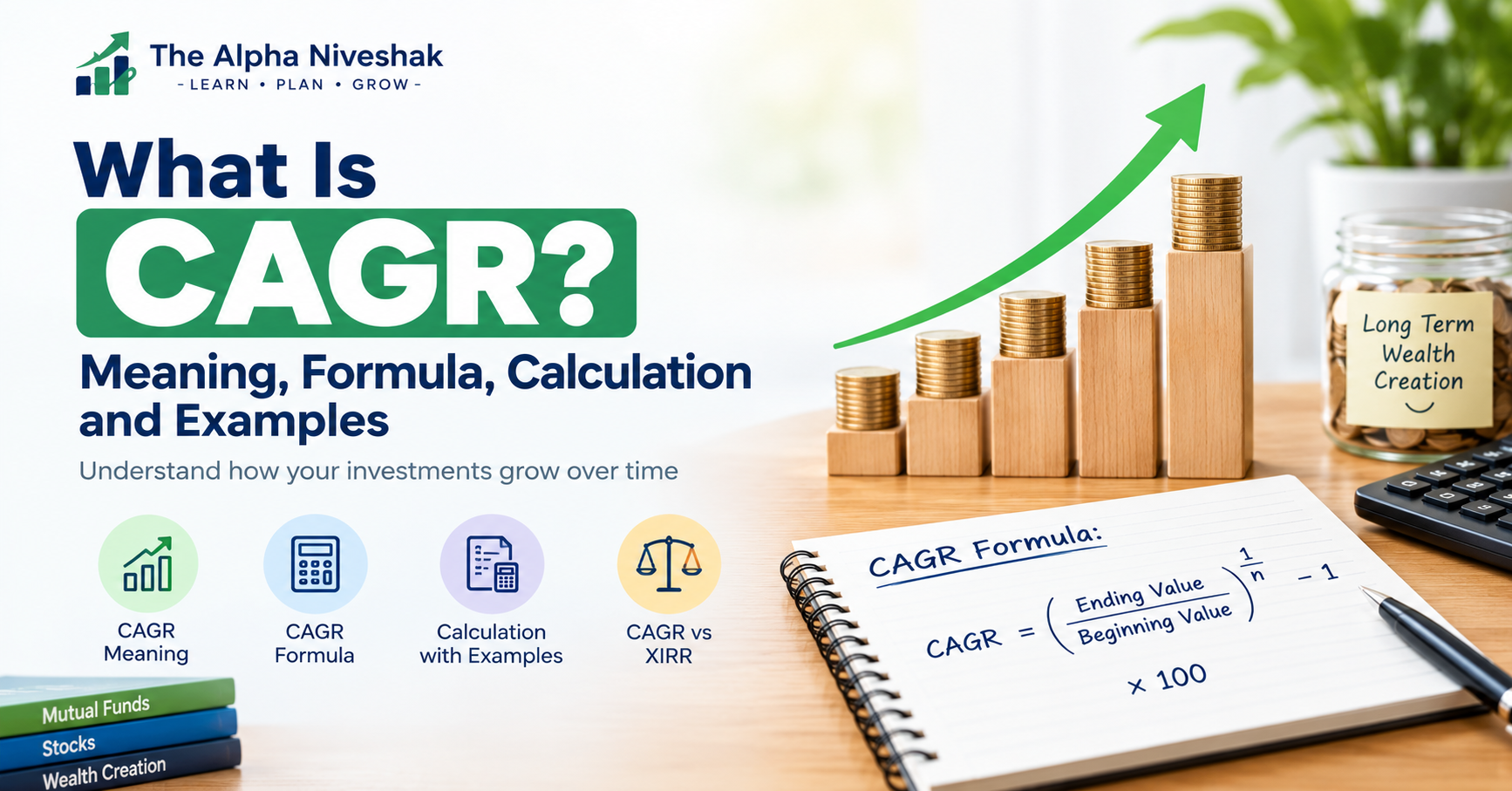
When you invest money in mutual funds, stocks, or other financial assets, understanding your investment returns is essential. However, looking only at the total profit may not tell you how quickly your investment has grown over time. This is where CAGR becomes useful.
CAGR, or Compound Annual Growth Rate, measures the annualized growth rate of an investment over a specific period, assuming it grew at a constant compounded rate. It helps investors understand and compare the growth of investments over multiple years.
In this article, we will explain what CAGR means, how to calculate it, provide practical examples, and discuss the difference between CAGR and XIRR.
CAGR stands for Compound Annual Growth Rate. It represents the constant annual growth rate that would take an investment from its starting value to its ending value over a given period, assuming annual compounding.
For example, suppose you invest ₹50,000 in a mutual fund, and its value grows to ₹80,000 after five years. CAGR helps you calculate the equivalent annualized growth rate over those five years.
CAGR is commonly used to evaluate:
CAGR is a useful measurement tool, but it does not mean that your investment earned the same percentage return in every year.
The CAGR formula is:
CAGR = [(Ending Value / Beginning Value)^(1 / Number of Years) − 1] × 100
Where:
This formula is most appropriate for an investment with a single starting value and a single ending value, without additional contributions or withdrawals.
Let’s understand CAGR with a simple example.
Suppose you invest ₹1,00,000 in a lump-sum investment. After three years, its value increases to ₹1,50,000.
Your investment details are:
Using the CAGR formula:
CAGR = [(1,50,000 / 1,00,000)^(1 / 3) − 1] × 100
CAGR = [(1.5)^(1 / 3) − 1] × 100
CAGR ≈ 14.47% per year
This means the investment grew at an equivalent compounded annual rate of approximately 14.47%.
It does not mean the investment actually returned 14.47% in each of the three years. Its annual returns could have been different, including positive or negative returns.
You can calculate CAGR easily using Microsoft Excel or Google Sheets.
Follow these steps:
Step 1: Enter the initial investment.
Enter ₹1,00,000 in cell A1.
Step 2: Enter the final value.
Enter ₹1,50,000 in cell A2.
Step 3: Enter the investment period.
Enter 3 in cell A3 to represent three years.
Step 4: Apply the CAGR formula.
Enter this formula in another cell:
=(A2/A1)^(1/A3)-1
Step 5: Format the result as a percentage.
The result will be approximately 14.47%.
You can use this method to calculate the annualized growth rate of many lump-sum investments, provided the starting value, ending value, and period are known.
CAGR and absolute return measure investment performance differently.
Absolute return calculates the overall percentage gain or loss relative to the initial investment. CAGR expresses the equivalent annual compounded growth rate over the investment period.
For example, suppose an investment increases from ₹1,00,000 to ₹1,50,000 over three years.
The absolute return tells you how much the investment grew overall, while CAGR helps you understand its annualized growth rate.
CAGR and XIRR are both used to understand investment returns, but they are appropriate for different cash-flow situations.
| Feature | CAGR | XIRR |
|---|---|---|
| Full form | Compound Annual Growth Rate | Extended Internal Rate of Return |
| Best suited for | Single lump-sum investment | Investments with multiple dated cash flows |
| Considers individual cash-flow dates | No | Yes |
| Common use | Long-term lump-sum growth | SIPs and irregular investments |
| Output | Annualized growth rate | Annualized return based on dated cash flows |
CAGR is generally suitable for evaluating a lump-sum mutual fund investment over a specific period. XIRR is generally more appropriate when evaluating an SIP because each installment is invested on a different date.
For example, if you invest ₹5,000 every month in a mutual fund, XIRR can account for the dates of the individual installments. CAGR alone cannot accurately represent the return on these multiple cash flows.
There is no single CAGR that is considered good for every mutual fund. Investment returns depend on the fund category, market conditions, investment duration, and the level of risk taken.
When evaluating CAGR, consider these factors:
1. Compare similar funds: Compare funds with similar investment objectives and suitable benchmarks.
2. Consider the investment period: Short-term performance may be influenced by temporary market movements. Longer periods can provide additional context, although they do not guarantee future results.
3. Evaluate risk: A higher CAGR does not necessarily mean a better investment. The fund may have experienced greater volatility or taken higher risks.
4. Review expenses and taxes: Fund expenses are generally reflected in the NAV, while personal taxes and applicable transaction costs may affect your final realized return.
5. Avoid relying on past performance alone: Consider your financial goals, investment horizon, diversification, and risk tolerance before making investment decisions.
CAGR should be used as one measure of investment performance rather than as a promise of future returns.
Although CAGR is useful, it has several limitations.
Understanding these limitations helps investors use CAGR more effectively when comparing investments.
CAGR stands for Compound Annual Growth Rate. It measures the equivalent annual compounded growth rate of an investment over a specified period.
CAGR is calculated by dividing the ending value by the beginning value, raising the result to the power of one divided by the number of years, subtracting one, and multiplying by 100.
A 12% CAGR may be attractive for some investments, but whether it is good depends on the asset class, investment period, risk, benchmark, costs, and your financial goals. It should not be treated as a guaranteed return.
No. CAGR is an equivalent annualized growth rate across the entire investment period. The actual return earned in any individual year may be higher or lower.
Yes. If an investment’s ending value is lower than its beginning value, CAGR will be negative, assuming a positive beginning value and a valid investment period.
CAGR is not generally the right standalone measure for an SIP because it does not account for the dates of individual contributions. XIRR is usually more suitable for calculating SIP returns.
Neither is universally better. CAGR is useful for measuring the compounded growth of a single investment, while XIRR is useful when investments or withdrawals occur on different dates.
CAGR is an important financial metric that helps investors understand the annualized growth of an investment over time. It is particularly useful for comparing lump-sum investments, mutual funds, stocks, and other assets over a defined period.
However, CAGR does not show the actual return earned in each year and cannot guarantee future performance. For investments involving regular SIP installments or irregular cash flows, XIRR is generally the more appropriate measure.
By understanding both CAGR and XIRR, investors can evaluate investment performance more accurately and make better-informed financial decisions.
Disclaimer: This article is for educational purposes only and does not constitute investment advice. Investments in securities and mutual funds are subject to market risks. Read all scheme-related documents carefully before investing.