Physical Address
304 North Cardinal St.
Dorchester Center, MA 02124
Physical Address
304 North Cardinal St.
Dorchester Center, MA 02124

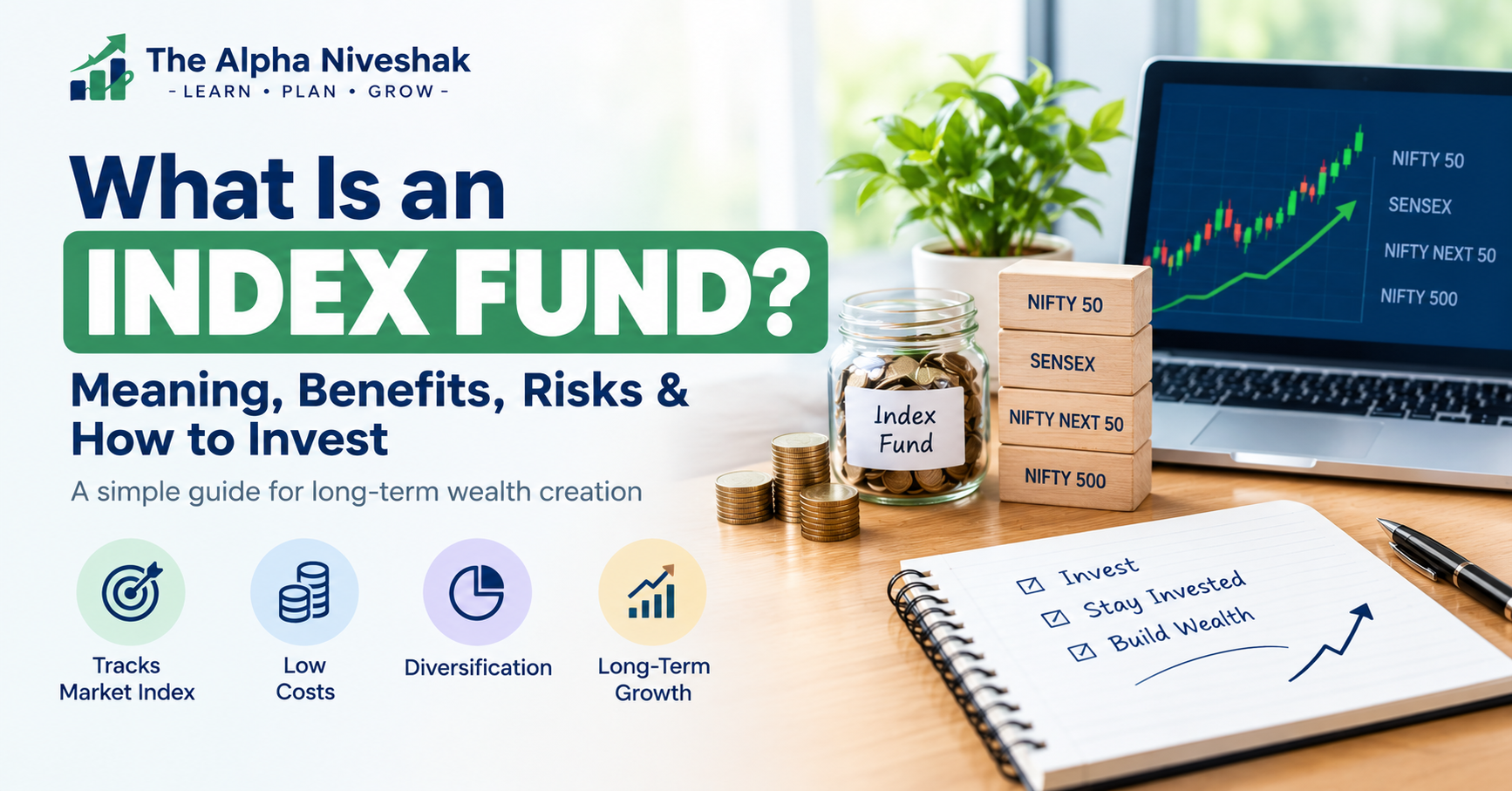
Investing in the stock market can seem complicated, especially for beginners who are unsure which stocks or mutual funds to choose. An index fund offers a simple way to invest in a group of securities without having to select individual stocks yourself.
Index funds have become an important part of long-term investing because they generally follow a passive investment strategy, aim to track a market index, and often have relatively low management costs.
But what exactly is an index fund, how does it work, and is it suitable for your financial goals? In this guide, we will explain index funds in simple language, with examples relevant to Indian investors.
An index fund is a type of mutual fund that aims to replicate the performance of a specific market index by holding the securities included in that index, or using another permitted tracking method.
A market index measures the performance of a selected group of securities. For example, the Nifty 50 represents 50 major companies listed on India’s National Stock Exchange, subject to the index’s selection and weighting rules.
A Nifty 50 index fund aims to provide returns that broadly track the Nifty 50 Total Return Index (TRI), after expenses and tracking differences.
Instead of relying on a fund manager to actively choose stocks in an attempt to outperform the market, an index fund follows a predefined index.
In simple terms, an index fund allows you to invest in a basket of securities through a single investment.
Index funds generally follow a passive investment strategy. Their primary objective is to track a selected index rather than consistently outperform it.
Here is how the process works:
The fund chooses an index to track, such as the Nifty 50, Nifty Next 50, or Nifty 500.
The fund holds securities in proportions designed to reflect the index. The exact method depends on the fund’s investment strategy and the index’s composition.
When the index methodology requires companies to be added, removed, or reweighted, the fund adjusts its portfolio accordingly.
Investors purchase units of the index mutual fund. The value of these units changes with the fund’s net asset value (NAV).
If the underlying index rises, the fund will generally benefit. If the index falls, the fund will generally lose value. Fund expenses and tracking differences mean its return will not exactly match the index return.
Suppose you invest ₹10,000 in a Nifty 50 index fund.
For illustration, assume the underlying index delivers a 10% return over a particular period. If the fund tracks it closely, its return before considering your personal taxes could be approximately 10% minus the effect of fund expenses and tracking differences.
At an illustrative net return of 9.8%, your investment would grow to approximately ₹10,980 over that period.
This is only a hypothetical example, not a forecast or a guaranteed return. Actual index fund returns depend on market performance, expenses, and tracking differences.
Indian investors can choose from several types of index funds depending on their investment objectives and risk tolerance.
These funds track the Nifty 50, an index representing 50 major companies listed on the National Stock Exchange.
They provide exposure to large Indian companies across different sectors, according to the index’s composition.
Sensex index funds aim to track the BSE Sensex, which represents 30 major companies listed on the Bombay Stock Exchange.
They offer another way to invest in a basket of large Indian companies.
These funds track the Nifty Next 50, which represents companies outside the Nifty 50 among the eligible constituents of the broader Nifty 100.
Their sector and company exposure differs from that of Nifty 50 funds, and their performance can be more volatile.
These funds aim to track the Nifty 500, providing exposure to a broader range of companies across market capitalisations.
A broader index does not eliminate market risk, and the fund’s actual diversification depends on the index’s composition and weighting.
Some funds provide exposure to overseas markets by tracking international indices, such as the S&P 500.
These investments can involve additional risks, including currency movements, international market volatility, and changes in regulations or fund availability.
Index funds offer several potential benefits for investors.
An index fund can provide exposure to multiple companies through a single investment. This reduces dependence on the performance of an individual company, although it does not eliminate overall market risk.
Because index funds generally follow a passive strategy, they often have lower expense ratios than actively managed funds. However, costs vary between schemes, so investors should compare the total expense ratio before investing.
Investors do not need to research and select individual stocks themselves. The fund follows its benchmark’s rules.
The underlying index and its methodology are generally publicly available. Investors can examine the index constituents and understand the market exposure they are taking.
Equity index funds may be considered by investors seeking long-term market exposure who can tolerate fluctuations and potential losses.
However, suitability depends on the investor’s financial goals, investment horizon, and ability to handle risk.
Although index funds can be simple and cost-effective, they are not risk-free.
Equity index funds fall when their underlying markets decline. Investors can lose part or all of the money invested in extreme circumstances.
An index fund aims to track its benchmark rather than avoid falling markets. It does not automatically move into cash when stock prices decline.
Tracking error measures the variability of the difference between a fund’s returns and its benchmark’s returns over time.
A fund may not perfectly replicate its index because of expenses, cash holdings, trading costs, and portfolio adjustments.
Some indices have significant exposure to particular companies or sectors. Owning an index fund does not guarantee equal exposure across all sectors or companies.
International index funds can be affected by exchange-rate movements as well as changes in the underlying foreign markets.
Investors should understand the fund’s benchmark, costs, and risks before investing.
Both index funds and actively managed mutual funds invest in securities, but they follow different strategies.
| Feature | Index Fund | Actively Managed Fund |
|---|---|---|
| Investment strategy | Tracks an index | Manager selects investments |
| Main objective | Replicate benchmark performance | Typically aims to outperform a benchmark or meet a specific objective |
| Expense ratio | Often lower | Often higher |
| Portfolio decisions | Primarily follow index rules | Based on the fund manager’s strategy |
| Market risk | Depends on the underlying index | Depends on the fund’s investments and strategy |
| Potential performance | Before costs, aims to match the index | May outperform or underperform its benchmark |
Neither approach is guaranteed to perform better. The right choice depends on your goals, preferences, costs, and tolerance for risk.
Index funds and exchange-traded funds (ETFs) can both track market indices, but their trading mechanisms differ.
Traditional index mutual funds are generally bought or redeemed through the fund at the applicable NAV, subject to scheme rules and cut-off requirements.
ETFs trade on stock exchanges during market hours at market prices. Investors generally need a demat and trading account to buy or sell ETF units.
Both can provide index-based exposure, but investors should compare expenses, tracking performance, liquidity, and transaction costs.
If you are considering investing in an index fund, follow these steps.
Decide why you are investing, such as long-term wealth creation or retirement planning. Consider when you will need the money.
Understand what the index represents. A Nifty 50 fund and a Nifty 500 fund offer different market exposures.
Review the fund’s expense ratio, tracking error, tracking difference, fund size, and investment process. Lower costs can be beneficial, but costs should not be the only selection criterion.
Review the scheme information document, key information memorandum, riskometer, and other relevant disclosures.
Direct plans generally have lower expense ratios because they do not include distributor commissions. Regular plans involve distribution through an intermediary. The appropriate option depends on your need for advice and support.
A lump-sum investment involves investing an amount at once. A Systematic Investment Plan (SIP) allows you to invest at regular intervals.
An SIP helps create a regular investing habit, but it does not guarantee profits or protect against market losses.
Check whether the fund continues to meet your goals and tracks its benchmark appropriately. Avoid making decisions based solely on short-term market movements.
Index funds may be worth considering for beginners who want a straightforward way to gain diversified market exposure without selecting individual stocks.
However, an equity index fund may not be suitable for money needed in the near future, because its value can decline significantly during market downturns.
Before investing, consider your emergency savings, existing financial obligations, investment horizon, and tolerance for losses. Investors who are unsure about their allocation may benefit from consulting a qualified financial adviser.
An index fund is a mutual fund that aims to follow a market index by investing in the securities represented in that index. It provides exposure to a group of securities through one investment.
Index funds are not risk-free. Equity index funds are exposed to market fluctuations and can lose value. Their risk depends on the index they track and the securities it contains.
Some mutual fund schemes allow investments starting at ₹500, including through eligible SIPs. The minimum amount varies by scheme, so check the scheme’s current investment requirements.
Some schemes may distribute income when permitted by their structure and applicable rules. In India, mutual fund options generally include Growth and Income Distribution cum Capital Withdrawal (IDCW). Growth options reinvest income within the scheme, while IDCW distributions are not guaranteed and reduce the scheme’s NAV when paid.
Yes. If the underlying index declines, the fund’s NAV can fall. The value of your investment may be lower than the amount you invested when you sell your units.
This is not an exact comparison. An index fund is an investment product, while an SIP is a method of investing regularly in a mutual fund. You can invest in an index fund through an SIP if the scheme offers that facility.
The appropriate duration depends on the index, your financial goal, and your ability to withstand losses. Equity index funds are generally more suitable for long-term goals than for short-term expenses, but no investment period guarantees positive returns.
Index funds provide a straightforward way to invest in a market index without selecting individual securities. Their potential advantages include diversification, transparency, and often lower costs than actively managed funds.
However, index funds still carry market risk, and their performance depends on the index they track. Before investing, compare costs, understand the underlying index, and choose an investment approach that aligns with your financial goals and risk tolerance.
Learning how index funds work can help you make more informed decisions as you build your understanding of the stock market and long-term investing.
Disclaimer: This article is for educational purposes only and does not constitute investment advice. Mutual fund investments are subject to market risks. Read all scheme-related documents carefully before investing.